THE BUSINESS PROBLEMHow can a business figure out which AI tools fit its needs and are worth using?
RESULT & STATUSIn development: business questions, scoring and financial models to support AI tool recommendations. The product has not launched.
I defined an assessment to help businesses choose suitable AI tools. I shaped the business questions, clarified which workflows to assess, and reviewed the assumptions used to judge potential value. How I build and review →
The assessment starts with how a business works and where it needs help. Its purpose is to identify suitable AI tools and explain why they fit. The workflow questions and financial estimates support that choice.
My decisions
Ask for a clear number
Replace ambiguous numeric ranges with one plainly labeled value so an owner can understand what a question asks.
Make assessment scope explicit
Allow one to three workflow deep dives and state the customer-selected scope transparently.
Separate benefit types
Keep capacity value distinct from cash savings, gross-profit opportunity and risk instead of presenting one blended savings figure.
One part of the assessment
Would an AI tool help enough to be worth considering?
The full product is designed to help a business choose the AI tools it needs. This example shows one supporting step: estimating potential time savings. Change the workload or labor-cost assumption to see how the estimate responds.
Interactive controls are unavailable until this example loads. The complete annotated example is below.
Interactive example · Fictional dataProduct in development
Cash savings: not established. Capacity value becomes cash savings only when an actual cost reduction is supported by evidence.
Interactive example · fictional data. Choices stay on this page and reset on reload or when you select Reset example.
This example estimates potential capacity only. It does not select or recommend AI tools; those recommendations are the intended purpose of the full assessment product.
The interactive example couldn’t continue. Read the annotated example or reload to reset.
Read the annotated example
120 occurrences per month
1,440 annual occurrences × 10 minutes ÷ 60 = 240 work hours. At 50% removable work, gross capacity is 120 hours.
Subtract 24 review hours and 12 maintenance hours: 84 hours per year. At the sample $40/hour cost: $3,360 annual capacity value.
240 occurrences per month
Gross capacity is 240 hours; review is 48 hours. After 12 maintenance hours: 180 hours and $7,200 annual capacity value.
At zero volume, recovered time and value are zero rather than negative.
Unknown labor cost at 120/month: 84 hours can still be calculated. Monetary value is not estimated—labor cost evidence is needed. Cash savings are not established for any example.
Evidence and outcome
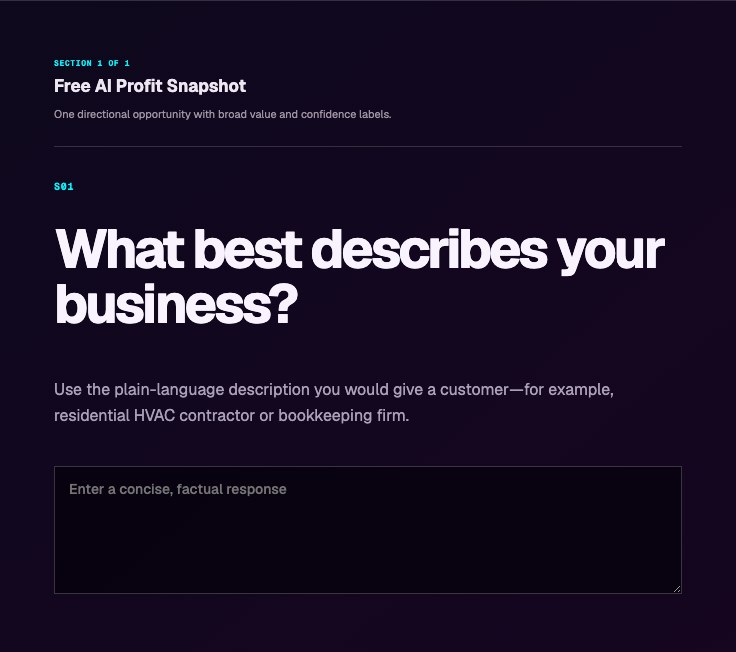
Actual assessment question · Unreleased local development preview · Captured September 2026
The project materials below show the requirements, decisions and workflow behind this case. Interactive examples use fictional data.
A product decision changed the question
I requested one clearly labeled number in place of confusing Low/High input pairs. I also separated the business category, how the service is delivered and what the business sells so each question has a clear purpose.
Before: a numeric range could leave the expected answer unclear.
Decision: request one plainly labeled number.
Related decision: separate business category from how the service is delivered.
Evidence: Assessment decision log D-017, D-022 and D-027; paraphrased.
A limited scope is still a valid scope
I made one workflow a valid starting point, with the option to explore up to three. The interface and report should make the customer’s chosen scope clear.
Evidence: Assessment decision D-018; paraphrased.
Financial logic makes deductions visible
The capacity calculation deducts ongoing review and maintenance from gross removable time, and floors net recovered hours at zero. The accompanying example uses that formula with openly stated fictional assumptions.
Evidence: Assessment calculation logic and illustrative portfolio scenario.
The goal is a practical recommendation about which AI tools a business actually needs. The development work supports that goal through business questions, workflow assessment and benefit modeling. The complete customer journey still needs testing before public release. This portfolio contains an illustrative scenario, not the released assessment. A live product link will be added after launch is confirmed.